

เมฆออร์ต
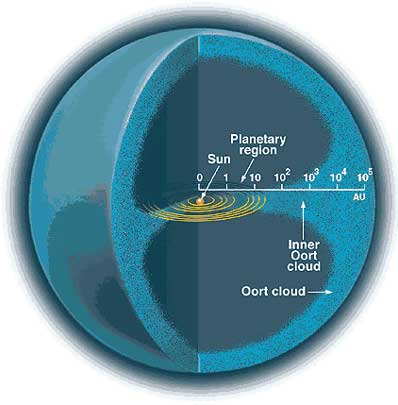
เมฆออร์ต (อังกฤษ: Oort cloud, ออกเสียง: /ɔːrt/ หรือ /ʊərt/)[1] บางครั้งเรียกว่า เมฆเอปิก–ออร์ต (Öpik–Oort cloud)[2] เป็นกลุ่มของเศษดาวเคราะห์น้ำแข็ง (icy planetesimals) จำนวนมหาศาลตามข้อสันนิษฐานที่เชื่อว่าห่อหุ้มดวงอาทิตย์อยู่ ณ ระยะห่างตั้งแต่ประมาณ 2,000 ถึง 200,000 AU (0.03 ถึง 3.2 ปีแสง)[3][4] การมีอยู่ของมันถูกเสนอขึ้นเป็นครั้งแรกในปี ค.ศ. 1950 โดยนักดาราศาสตร์ชาวดัตช์ ยัน ออร์ต (Jan Oort) เพื่อเป็นเกียรติแก่เขาในภายหลังจึงได้ตั้งชื่อตามแนวคิดนี้[5] ออร์ตเสนอว่าวัตถุในเมฆนี้จะคอยเติมเต็มและรักษาจำนวนของดาวหางคาบยาวที่เข้ามายังระบบสุริยะชั้นในให้คงที่ เนื่องจากดาวหางเหล่านี้มักถูกทำลายไปเมื่อโคจรเข้าใกล้ดวงอาทิตย์[6]
เมฆออร์ตเชื่อว่าแบ่งออกเป็นสองภูมิภาค ได้แก่ เมฆออร์ตชั้นในที่มีรูปทรงเป็นแผ่นจานขนานกับระนาบสุริยวิถี (เรียกว่า เมฆฮิลส์) และเมฆออร์ตชั้นนอกที่มีรูปทรงเป็นทรงกลมห่อหุ้มระบบสุริยะทั้งหมดเอาไว้ ทั้งสองภูมิภาคตั้งอยู่ไกลเกินขอบเขตของเฮลิโอสเฟียร์และอยู่ในอวกาศระหว่างดาว[4][7] ส่วนที่อยู่ลึกที่สุดของเมฆออร์ตนั้นอยู่ไกลจากดวงอาทิตย์มากกว่าแถบไคเปอร์, แถบจานกระจาย และวัตถุที่ถูกแยกออกมา (ซึ่งเป็นแหล่งกักเก็บวัตถุพ้นดาวเนปจูนที่อยู่ใกล้กว่า) ถึงกว่าหนึ่งพันเท่า[8]
ขอบเขตชั้นนอกของเมฆออร์ตถือเป็นขอบเขตทางกายภาพของระบบสุริยะ พื้นที่นี้ถูกกำหนดโดยทรงกลมฮิลล์ของดวงอาทิตย์ ซึ่งเป็นจุดรอยต่อระหว่างอิทธิพลแรงโน้มถ่วงของดวงอาทิตย์และกาแล็กซี[9] เมฆออร์ตชั้นนอกนั้นยึดเหนี่ยวกับระบบสุริยะเพียงหลวม ๆ วัตถุในบริเวณนี้จึงถูกกระทบได้ง่ายจากแรงโน้มถ่วงของดาวฤกษ์ที่เคลื่อนที่ผ่านไปมา, แรงจากทางช้างเผือก และแรงโน้มถ่วงจากตัวเมฆเอง[10] แรงเหล่านี้ส่งผลให้วงโคจรที่มีความรีสูงของวัตถุที่ถูกดีดออกมาจากระบบสุริยะชั้นในในช่วงยุคเริ่มแรกกลายเป็นวงโคจรที่ค่อนข้างกลมมากขึ้น[11] ในทางกลับกัน การรบกวนทางแรงโน้มถ่วงจากกาแล็กซีอาจทำให้วัตถุในเมฆออร์ตหลุดออกจากวงโคจรและพุ่งเข้าสู่ระบบสุริยะชั้นในกลายเป็นดาวหางได้[4]
นักดาราศาสตร์สันนิษฐานว่าวัตถุในเมฆออร์ตในปัจจุบันก่อตัวขึ้นใกล้กับดวงอาทิตย์ในจานดาวเคราะห์ก่อนเกิด แล้วจึงถูกเหวี่ยงออกไปสู่อวกาศอันไกลโพ้นด้วยอิทธิพลแรงโน้มถ่วงของดาวเคราะห์ยักษ์[4] ปัจจุบันเรายังไม่สามารถสังเกตการณ์เมฆออร์ตโดยตรงได้ด้วยเทคโนโลยีการถ่ายภาพที่มีอยู่[12] อย่างไรก็ตาม เชื่อกันว่ามันคือแหล่งต้นกำเนิดของดาวหางคาบยาวและดาวหางประเภทแฮลลีย์เกือบทั้งหมด รวมถึงอาจเป็นแหล่งกำเนิดของเซนทอร์และดาวหางตระกูลดาวพฤหัสบดีบางดวงด้วย[13]
อ้างอิง
[แก้]- ↑ "Oort". Oxford English Dictionary (Online ed.). Oxford University Press. (จำเป็นต้องสมัครสมาชิกหรือเป็นสมาชิกสถาบันที่เข้าร่วม.)
- ↑ Whipple, F. L.; Turner, G.; McDonnell, J. A. M.; Wallis, M. K. (1987-09-30). "A Review of Cometary Sciences". Philosophical Transactions of the Royal Society A. 323 (1572): 339–347 [341]. Bibcode:1987RSPTA.323..339W. doi:10.1098/rsta.1987.0090. S2CID 119801256.
- ↑ Williams, Matt (August 10, 2015). "What is the Oort Cloud?". Universe Today. สืบค้นเมื่อ May 21, 2021.
- 1 2 3 4 Lectures notes from 35th Saas-Fee advanced course. Alessandro Morbidelli (2006). "Origin and dynamical evolution of comets and their reservoirs of water ammonia and methane". arXiv:astro-ph/0512256.
- ↑ van der Kruit, Pieter C. (2020). Master of Galactic Astronomy: A Biography of Jan Hendrik Oort. Springer.
- ↑ Redd, Nola Taylor (October 4, 2018). "Oort Cloud: The Outer Solar System's Icy Shell". Space.com.
- ↑ อ้างอิงผิดพลาด: ป้ายระบุ
<ref>ไม่ถูกต้อง ไม่มีการกำหนดข้อความสำหรับอ้างอิงชื่อjpl.PIA17046 - ↑ Dones, Luke (2004). The Origin and Evolution of the Oort Cloud. Cambridge University Press. pp. 153–174.
- ↑ "Kuiper Belt & Oort Cloud". NASA Solar System Exploration web site. NASA. คลังข้อมูลเก่าเก็บจากแหล่งเดิมเมื่อ 2003-12-26. สืบค้นเมื่อ 2011-08-08.
- ↑ Correa-Otto, J. A.; Calandra, M. F. (2019). "The stability in the most external region of the Oort Cloud". Monthly Notices of the Royal Astronomical Society. 490 (2): 2495–2504.
- ↑ Fouchard, Marc; Froeschlé (2006). "Long-term effects of the Galactic tide on cometary dynamics". Celestial Mechanics and Dynamical Astronomy.
- ↑ "Oort Cloud". NASA Solar System Exploration. 20 June 2023.
- ↑ V. V. Emelyanenko; D. J. Asher; M. E. Bailey (2007). "The fundamental role of the Oort Cloud in determining the flux of comets through the planetary system". Monthly Notices of the Royal Astronomical Society. 381 (2): 779–789. Bibcode:2007MNRAS.381..779E. CiteSeerX 10.1.1.558.9946. doi:10.1111/j.1365-2966.2007.12269.x.
- Harold F. Levison; Luke Donnes (2007). "Comet Populations and Cometary Dynamics". ใน Lucy Ann Adams McFadden; Lucy-Ann Adams; Paul Robert Weissman; Torrence V. Johnson (บ.ก.). Encyclopedia of the Solar System (2nd ed.). Amsterdam; Boston: Academic Press. pp. 575–588. ISBN 978-0-12-088589-3.
- David C. Jewitt (2001). "From Kuiper Belt to Cometary Nucleus: The Missing Ultrared Matter" (PDF). Astronomical Journal. 123 (2): 1039–1049. Bibcode:2002AJ....123.1039J. doi:10.1086/338692. S2CID 122240711. คลังข้อมูลเก่าเก็บจากแหล่งเดิม (PDF)เมื่อ 2020-05-03.
- Thomas M. Donahue, บ.ก. (1991). Planetary Sciences: American and Soviet Research, Proceedings from the U.S.–U.S.S.R. Workshop on Planetary Sciences. Kathleen Kearney Trivers, and David M. Abramson. National Academy Press. p. 251. Bibcode:1991psas.conf.....D. doi:10.17226/1790. ISBN 978-0-309-04333-5. เก็บจากแหล่งเดิมเมื่อ 2014-11-09. สืบค้นเมื่อ 2008-03-18.
- Jack G. Hills (1981). "Comet showers and the steady-state infall of comets from the Oort Cloud". Astronomical Journal. 86: 1730–1740. Bibcode:1981AJ.....86.1730H. doi:10.1086/113058.
- Julio A. Fernández (1997). "The Formation of the Oort Cloud and the Primitive Galactic Environment" (PDF). Icarus. 219 (1): 106–119. Bibcode:1997Icar..129..106F. doi:10.1006/icar.1997.5754. เก็บ (PDF)จากแหล่งเดิมเมื่อ 2012-07-24. สืบค้นเมื่อ 2008-03-18.
- Harold F. Levison; Luke Dones; Martin J. Duncan (2001). "The Origin of Halley-Type Comets: Probing the Inner Oort Cloud". Astronomical Journal. 121 (4): 2253–2267. Bibcode:2001AJ....121.2253L. doi:10.1086/319943.
- "The Sun Steals Comets from Other Stars". NASA. 2010. เก็บจากแหล่งเดิมเมื่อ 2021-01-25. สืบค้นเมื่อ 2017-07-12.
- Jan Oort (1950). "The structure of the cloud of comets surrounding the Solar System and a hypothesis concerning its origin". Bulletin of the Astronomical Institutes of the Netherlands. 11: 91–110. Bibcode:1950BAN....11...91O.
- Horizons output. "Barycentric Osculating Orbital Elements for Comet C/1999 F1 (Catalina)". เก็บจากแหล่งเดิมเมื่อ 2021-06-02. สืบค้นเมื่อ 2021-06-01. Solution using the Solar System Barycenter. Ephemeris Type:Elements and Center:@0 (To be outside planetary region, inbound epoch 1950 and outbound epoch 2050. For epoch 1950-Jan-01 orbit period is "PR= 1.6E+09 / 365.25 days" = ~4.3 million years)
อ่านเพิ่ม
[แก้]- Arnett, Bill (March 2007). "The Kuiper Belt and The Oort Cloud". Nine Planets.
- Brasser, R.; Schwamb, M. E. (2015). "Re-assessing the formation of the inner Oort cloud in an embedded star cluster – II. Probing the inner edge". Monthly Notices of the Royal Astronomical Society. 446 (4): 3788. arXiv:1411.1844. Bibcode:2015MNRAS.446.3788B. doi:10.1093/mnras/stu2374. S2CID 17001564.
- Batygin, Konstantin; Raush, Dennis (2024). "Formation of the inner Oort cloud in the presence of an early solar binary". Monthly Notices of the Royal Astronomical Society: Letters. 533 (1): L43–L47. arXiv:2305.00999. doi:10.1093/mnrasl/slad107.
- Fouchard, M.; Rickman, H.; Froeschlé, C.; Valsecchi, G. B. (2023). "What long-period comets tell us about the Oort Cloud". Astronomy & Astrophysics. 671: A36. Bibcode:2023A&A...676A.104F. doi:10.1051/0004-6361/202243728.
- Hands, T. O.; Dehnen, W.; Gration, A. (2021). "Formation of extrasolar Oort clouds and the origin of interstellar objects". Astronomy & Astrophysics. 647: A96. arXiv:2011.08257. doi:10.1051/0004-6361/202038888.
- Matthews, R. A. J. (1994). "The close approach of stars in the solar neighbourhood". Quarterly Journal of the Royal Astronomical Society. 35: 1. Bibcode:1994QJRAS..35....1M.
- Oort, Jan H. (1950). "The structure of the cloud of comets surrounding the Solar System and a hypothesis concerning its origin". Bulletin of the Astronomical Institutes of the Netherlands. 11: 91–110. Bibcode:1950BAN....11...91O.
แหล่งข้อมูลอื่น
[แก้]
- Oort Cloud Profile (เก็บถาวร 2015-11-10 ที่ เวย์แบ็กแมชชีน) by NASA's Solar System Exploration